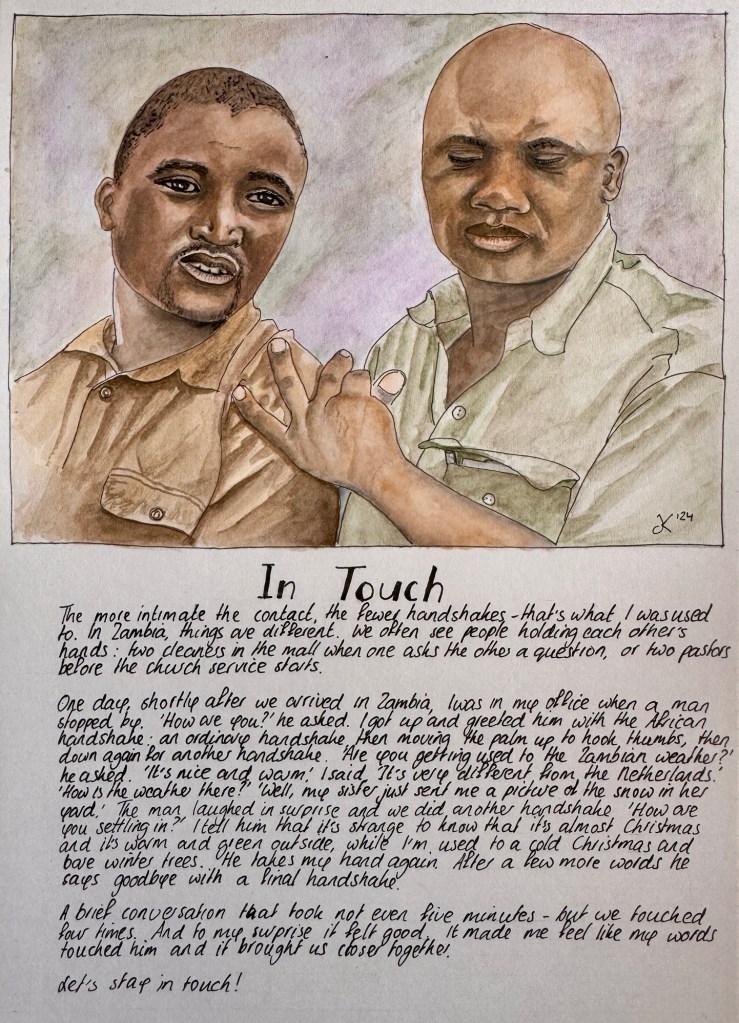
The more intimate the contact, the fewer handshakes – that’s what I was used to. Here, things are different. We often see people holding each other’s hands: two cleaners in the mall when one asks the other a question, or two pastors before the church service starts.
One day, shortly after we arrived in Zambia, I was in my office when a man stopped by. ‘How are you?’ he asked. I got up and greeted him with the African handshake: a handshake, then moving the palm up to hook thumbs, then down again for another handshake. ‘Are you getting used to the Zambian weather?’ he asked. ‘It’s nice and warm,’ I said, ‘It’s very different from the Netherlands.’ ‘How is the weather there?’ ‘Well, my parents just sent me a picture of the snow in their garden.’ The man laughs with surprise and shakes my hand again. ‘How are you settling in?’ I tell him that it’s strange that it’s almost Christmas and everything is green when I’m used to a cold Christmas with bare trees. He takes my hand again. After a few more words he says goodbye w ith a final handshake.
A brief conversation – not even five minutes – but we touched each other four times. And it felt good! It made feel like my words touched him and it brought us closer together. Let’s stay in touch!
40% of all fossil finds of hominids come from a relatively small area 60kms from where we live. It has become known as the Cradle of Humankind. Today we visited the Sterkfontein Cave in this region. Under an unassuming hill we found an impressive network of deep and roomy caves. At the end of the 19th century, these caves were mined for limestone. This limestone, made into quicklime, was used in the goldmines on the Witwatersrand. In the 1930s, the first Australopithicus (literally Southern Apeman) were found. The excavations continue until this day, and up until now some 500 hominids have been found. The hominids did not use the caves to live in. The most complete skeleton seems to have been from a boy who fell into the caves through a crack – but I’ve not been able to find whether all of them came into the caves in this way…
On the Lesotho side of the Sani Pass, there is a small Pentecostal church. Siphiwe, the pastor, showed us a traditional homestead and how to wear the traditional Lesotho blankets His wife had prepared some delicious bread in a pan on a cow dung fire. The church was not officially part of this cultural expierence, but we were allowed to look inside as well. Inside we found Siphiwe’s wife washing clothes – the church doubles as the pastor’s house and living room. On the wall there was this mural of a shepherd carrying a sheep. Most of the congregation consists of shepherds who come to the Sani Pass area in summer to graze their sheep. This image of the Good Shepherd clearly touched them. I think it’s a really strong, contextual image of the Gospel!
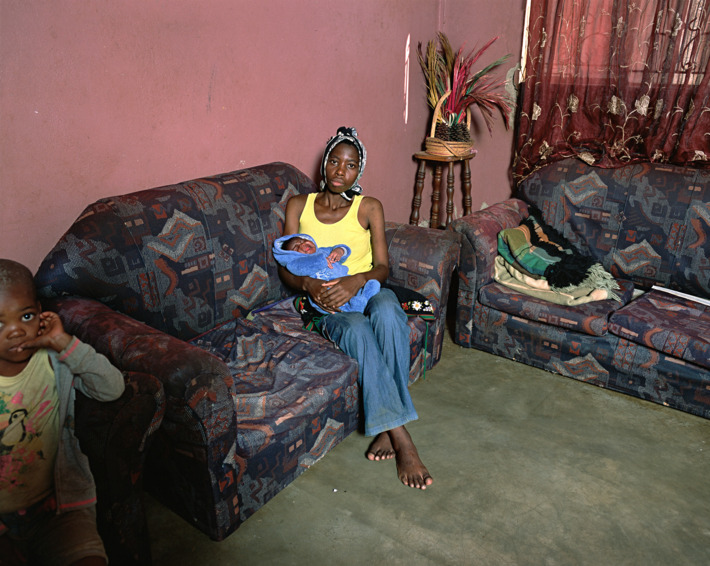
An image of a woman holding a crying baby in her living room, while another child seems to be flitting in and out of the frame. The sparse interior, the cheap curtains and the slightly dirty walls speak of poverty. The woman, however, looks into the camera with a challenging expression, as if she wants to say ‘yes, this is my life, what of it?’.
On the other hand, giving that true representation may be an impossibility. Every photograph is at least two steps away from the lived experience of its subject. First, the photographer chooses a frame and in doing so a particular perspective on the person portrayed. Second, the viewer of the finished photograph sees it from their own context. The viewer gives meaning to the photograph from his or her own history and experiences. These layered interpretations give plenty of opportunities to shift away from the reality of the person portrayed in the photograph.
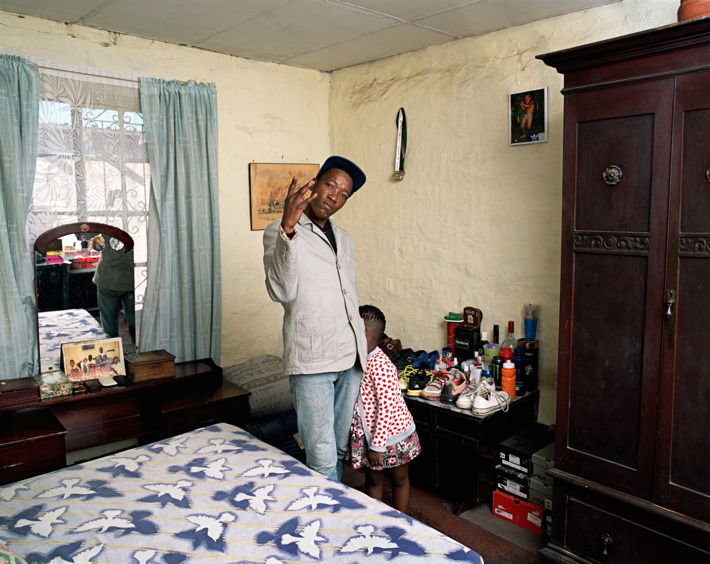
The gesture of the young man and the posture of the girl are all prompted by Lawson. In other photographs she rearranges interiors. The baby in the photo at the top is not the woman’s child. So whose world are we seeing in Lawson’s photographs? Are the similarities between photos taken in different countries an expression of an African diaspora aesthetics, or are the similarities due to Lawson’s choices in what to include in the frame, and how to pose the subjects? What gesture would the young man from Soweto make in his daily life, hanging out with friends? Maybe it would have been this West Side symbol, maybe he wants to claim this global connection his brothers – but because the photograph is staged we will never know.
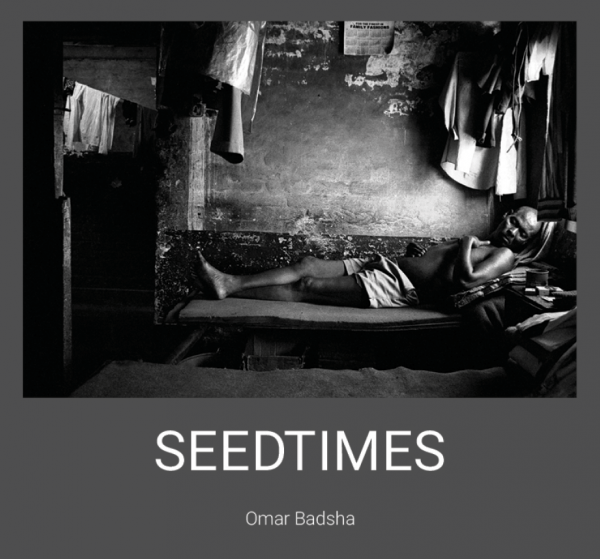
“Photography is not a photocopy of reality” my lecturer in photography said in our first class. A photo is not necessarily an accurate duplicate of the world, because it adds subjective feelings and opinions. Africa and Africans have been subjected to many othering discourses that add negative feelings and are based on unfavourable opinions. This is especially visible in the history of South Africa. Omar Badsha is a South African photographer who lived through the era of Apartheid. In a recent public debate at the University of Pretoria on occasion of the launch of his newest book Seedtimes, he explained how he uses photography to change the world.
Badsha is a self-taught photographer, who started out taking pictures of the work circumstances of chemistry workers to assist the advocacy of their trade union. He also photographed people in townships and protest actions against Apartheid. “I use photography like an author who uses words, or a painter who uses paint,” he says, “to express what happens in a community.” This does not mean showing only the problems and misery in the townships. “I photograph their everyday rituals. I use the camera to explore the space they create, and the dignity they have.”
The point of Badsha’s photography is not creating art, or purely documenting life. He uses photography to agitate for change. This change should happen not only in actual living circumstances, but also in the way people think. The people he captures in his photographs are the major actors in changing society, and in his photography, Badsha aims to empower them and change their mindset. Being black in Apartheid times meant being worth less than a white person, a notion that penetrates and diminishes the sense of self and personhood. The goals of Badsha’s photography is to tell a different story. “We are human, not just black”, Badsha says. “The central concern in our art was to articulate what it is to be a black person.” Photography is a strong tool to do this. Instead of portraying black people in a stereotyped way, as exotic individuals or as inferior beings, Badsha’s photography shows them as humans. “In the book you see relationships. You see a father and a son, a mother and a child. You see lovers. This is a different narrative than the stereotype.”
Photography should bring people together in a common humanity, instead of enforcing the stereotype of the exotic or inferior other. Seedtimes is a valuable retrospective on the work of an inspiring photographer who uses photography as political activism to change the world.
One of the most renowned photographers of people on the margin was the American artist Diane Arbus (1923-1971). She took pictures of those who were deemed ‘not normal’: dwarfs and giants, circus performers, nudists, and transgender people, trying to show worlds that other people do not see. But whose world is pictured in a photographer’s work?
Diane Arbus, 1962, Child with Toy Hand Grenade in Central Park
One of her most famous photographs shows a boy in a park, playing with a toy hand grenade. With his hands clenched, the boy looks into the camera. He appears about to explode. The striking pose of the kid has been interpreted as symbolizing the closeness between child’s play and primal violence. It is a photograph of something that we would not ordinarily see. It is a disturbing picture that triggers our emotions. It allows us to access – or at least be aware of – a different world.
But whose world are we experiencing in the photograph of the boy with the toy hand grenade? Critics of Arbus’ work have pointed out that in the contact sheet that shows the whole series of images Arbus took of the boy, this is the only disturbing image. On the others, we see an ordinary boy fooling around in a park. The choice of printing this image of a disturbing and disturbed kid is Arbus’ own.
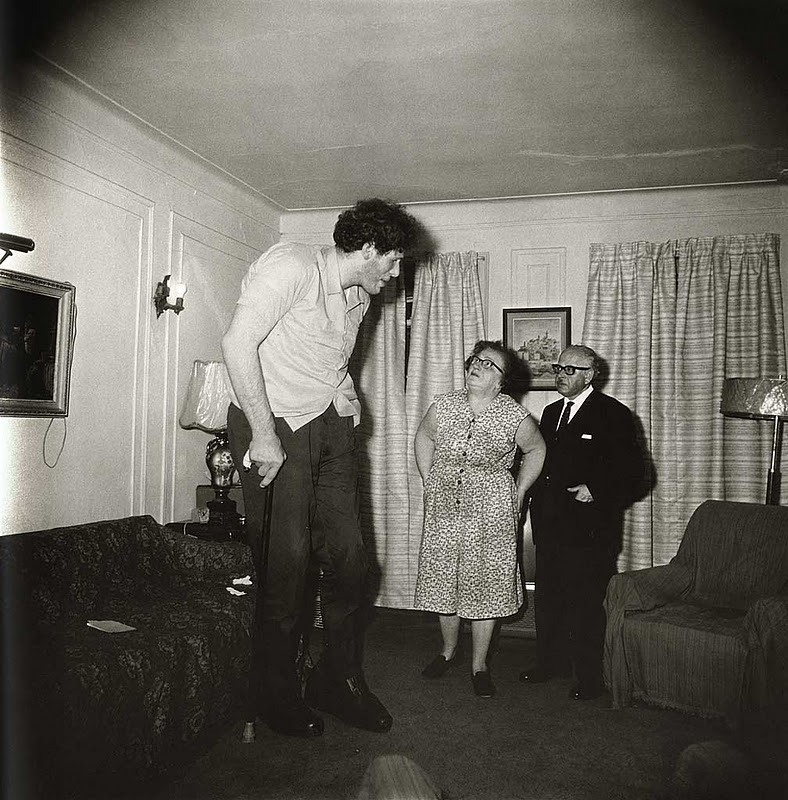
Diane Arbus, 1970, A Jewish Giant Home with his Parents in the Bronx
I wonder if this is what we see. Do we see in this image how a giant has a normal family life, just like we do? Or do we see a freakish man who would fit better in a circus? To put it boldly: Do we see the man or the monster? The answer to these questions lies in the viewer of the photograph, of course. But it is also influenced by the photographer who takes the picture. Does Arbus help us to experience and share the world of the people she portrays, or is she enforcing stereotypes?
Arbus is not like the ‘poverty porn’-photographers who excel in portraying people in the most horrid circumstances with the aim to raise pity that can be bought off by giving a donation. But avoiding that pitfall does not raise her photography beyond dispute. On the flip side of poverty porn there is an equally objectionable place of othering, where people are reduced to freaks.
What does this mean for my quest to be an ethnographic photographer? Navigating between the undesirable poles of poverty porn and freak shows might be a tough challenge for a photographer portraying the lives of ordinary people in Africa.
Recently, National Geographic asked a historian to examine the photographs about Africa and Asia in its archives. “For decades, our coverage was racist”, was the conclusion that made the headline.
The voices of black Africans did not feature in articles, and photographs pictured them in a stereotypical way: doing tribal dances, or staring enthralled at the modern equipment of the photographer. In this way, Africans are (quite literally) portrayed as not on par with the Western reader. They are traditional where the reader is modern; they live in villages instead of cities; they have not reached a Western level of development.
The ways in which Africa and Africans – or, better: Zambians, South Africans, Kenyans, Nigerians, etc. – are portrayed is an issue that receives increasing attention. In National Geographic, the stereotypical African is the ‘noble savage’, someone who is still in touch with nature, with their roots and with the community; unspoiled by the rationalizations, disenchantments and individualization of modernity. Another stereotype is triggered by charities and by media covering disasters. We all know these images: African children with flies crawling on their faces and bellies swollen with hunger oedema.
This image of Africa has been labelled as ‘poverty porn’. People in these photographs are portrayed when they are at their most vulnerable. The objective is to generate pity or sympathy, and subsequently to increase donations to the charity. The donations are for a good cause, but these images keep telling us that Africans need to be saved. They are victims. They are not able to help themselves. In a Ted-talk, Nigerian writer Chimamanda Ngozi Adichie says: “The problem with stereotypes is not that they are untrue, but that they are incomplete. They make one story become the only story.”
There really are pitiable children suffering from famines – photos portraying them are not staged. But there is more to Africa than this. More than noble savages and beautiful nature; and more than suffering victims and “shithole countries”. Photographers, wherever they come from, and whoever pays them, should be aware of the power of their images in enforcing harmful stereotypes.
Why am I writing this? I am an anthropologist and photographer living in southern Africa. It is my aim to picture the people whom I encounter in an honest way. The issues addressed in this blog sometimes make me feel I am traversing a minefield. I hope to use this blog to plot my course, avoiding the pitfalls mentioned here, and reflecting on a number of issues related to imaging (or imagining) Africa.




 Awesome wonder